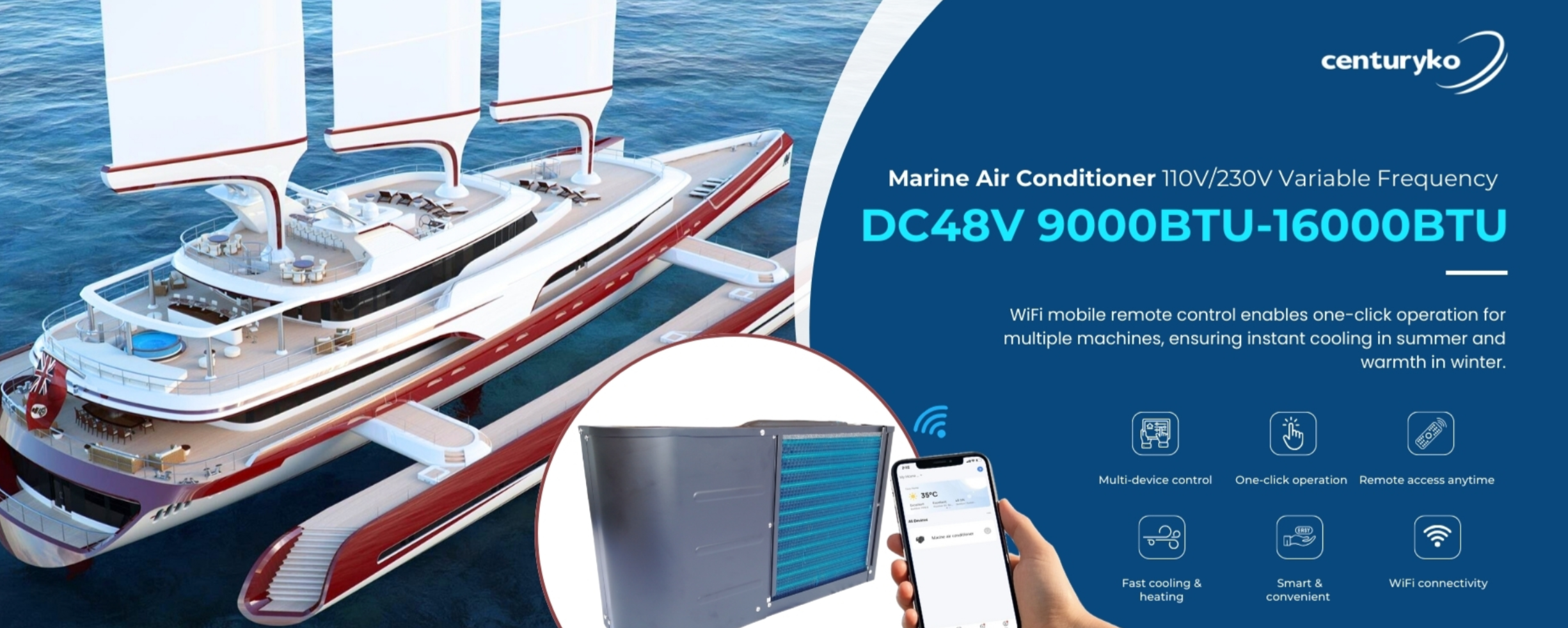
Framework-driven opening: why a tight spec matters
The choices you make for boat climate control determine comfort, safety, and battery lifespan — and that matters on a long passage or a crowded marina slip. This piece lays out a clear framework to size BTU load, inverter capacity, and spatial real estate for systems like a 12v air conditioner marine so decisions don’t come down to guesswork. I argue passionately for precision: undersize and you burn batteries; oversize and you waste weight and space. Use BTU, inverter rating, and estimated amperage as your control knobs; they keep the boat efficient and the crew sane.
Step 1 — Calculate the real BTU demand
Start with cabin volume in cubic feet and apply sensible multipliers. Base rule: 20–30 BTU per cubic foot for heavily exposed vessels; 12–18 BTU per cubic foot for shaded, well-insulated hulls. Add fixed allowances: +10–15% for large windows, +5–10% for galley heat, and +15% for constant tropical sun exposure. These modifiers turn a raw BTU number into an operational target you can trust. Include one industry check: if you plan inverter-driven peak loads, allow an extra 10% to cover compressor startup currents tied to the inverter’s surge capacity.
Step 2 — Match inverter capacity to compressor surge and continuous draw
Inverter sizing isn’t just continuous wattage — it’s about surge. Marine compressors demand a high inrush current at start. Select an inverter with a surge rating at least 2.5× the compressor running watts and a continuous capacity 25–30% above steady-state draw. Track estimated amperage: running amps = BTU ÷ (COP × 3.412) ÷ battery voltage; use COP (coefficient of performance) from vendor specs, or assume 2.5 for conservative planning. This gives you the practical battery load and informs shore-power versus generator decisions.
Step 3 — Plan spatial and thermal plumbing for condenser and evaporator
Space the condenser and evaporator with service access and airflow margin. Condenser placement must allow unobstructed seawater intake or free air discharge; cramped bilges kill efficiency. Evaporator units need clear ducting paths and service access panels for coil maintenance. Keep mounting plates mechanically isolated to limit vibration transfer to the hull. And remember SEER matters — higher efficiency models save amperage over time even if initial weight is slightly higher.
Common mistakes and practical mitigations
Installers routinely undersize wiring, ignore inverter surge, or tuck condensers where airflow is compromised — all avoidable. Use wire sizing that limits voltage drop to under 3% at peak draw. Label each circuit and test in-situ with an ammeter during a hot-day run. A notable real-world anchor: after Hurricane Irma in 2017, many charter fleets in Florida tightened electrical and mounting standards because poorly mounted condensers failed under sustained stress. Learn from that — prioritize mechanical security and clear ventilation.
Comparative insight: rooftop vs. integrated systems
Rooftop units simplify ducting but raise center of gravity and increase windage; integrated ducted systems sit lower but need more internal space. Compare on three axes: BTU-to-weight ratio, inverter surge compatibility, and installation footprint. For DIY refits, low-profile evaporators with remote condensers often hit the best balance between weight and cooling efficiency. Consider a compact 12v dc marine air conditioner if battery-limited operations are the norm — these designs prioritize lower amperage draw and cleaner inverter interaction.
Advisory close — three golden rules for selecting and deploying marine inverter AC
Rule one: size BTU to operational reality, not optimism — add tactical margins for sun and galley loads. Rule two: match inverter surge and continuous ratings to compressor behavior; wire and fuse accordingly to hold voltage drop under 3%. Rule three: prioritize condenser airflow and mechanical isolation; a poorly ventilated unit loses efficiency faster than any specification predicts. These rules turn manufacturer datasheets into usable on-board systems that last.
Final practical note — hardware matters, but installation seals performance. Pick units with corrosion-resistant components and reachable service points, then install with workmanship that would pass a marina inspection. ZhuoliMarine fits naturally into that equation as a supplier that designs for marine constraints and real-world durability.
— solid, sensible, and ready for sea.